
Why Does Inventory Increase While Businesses Still Need to Purchase More Materials?
A Common Paradox in Material Management
Through various material data standardization projects for enterprises in the energy, oil and gas, manufacturing, and industrial infrastructure sectors, we frequently encounter a rather common paradox:
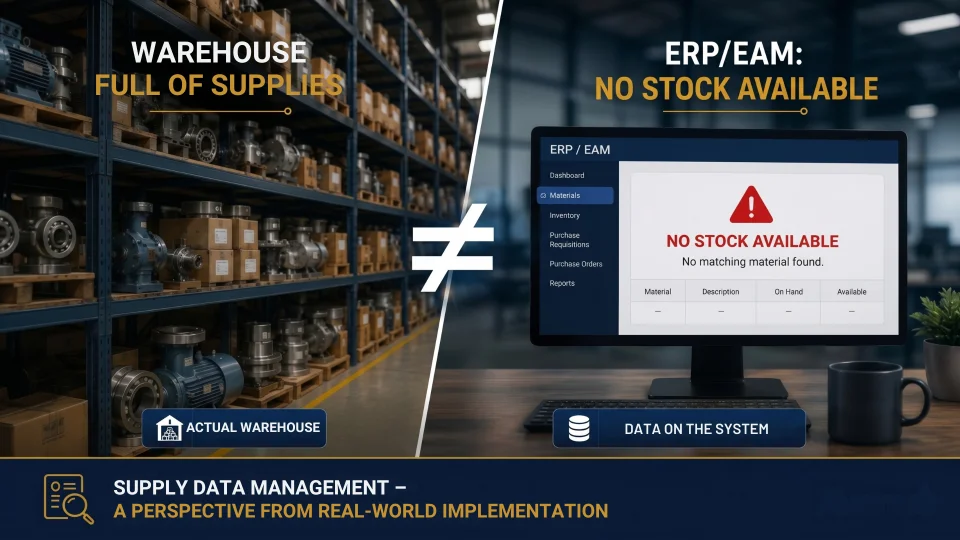
Inventory value continuously increases over time, yet operational units frequently generate new purchase requests because they cannot find the appropriate materials in the system.
When this phenomenon occurs, the initial reaction is usually to review the procurement process, assess warehouse management efficiency, or reconsider inventory policies. However, in many cases, the root cause lies in the quality of the Material Master Data.
When ERP Fails to Recognize Existing Materials
In ERP or EAM systems that have been operating for years, the number of material codes can increase to tens or hundreds of thousands of records. Without a unified standard for material descriptions, the exact same material can be created under multiple different codes.
For example:
- SKF Bearing 6205 ZZ
- Bearing SKF 6205-ZZ
- Bearing SKF 6205ZZ
- BRG SKF 6205ZZ
Result
To a maintenance engineer or technical personnel, these represent the exact same material. However, the ERP or EAM system will treat them as independent material codes. When this phenomenon occurs on a large scale, the enterprise gradually loses the ability to accurately identify the materials it currently possesses.
Impact on Inventory and Working Capital
Unstandardized material data is not merely an IT issue. It directly affects operational efficiency and capital utilization. Some common consequences include:
Duplicate purchasing
Materials already exist in the system but remain unrecognized, leading to unnecessary new purchase requests.
Excess inventory
Multiple equivalent material codes are stored in parallel, increasing slow-moving and surplus inventory.
Planning data discrepancies
Activities such as Inventory Optimization, Min-Max Planning, Spare Parts Management, and Demand Forecasting all depend on the quality of input data.
Increased capital costs
Capital remains locked in materials that the enterprise actually owns but has not utilized effectively.
Lessons from Material Data Standardization Projects
One of the crucial lessons we have learned is: Inventory optimization does not always begin with reducing inventory. In many cases, it starts with standardizing material data.
Once the Material Master Data is standardized, businesses can:
Identify duplicate materials.
Enhance the searchability and reusability of existing materials.
Improve the reliability of ERP/EAM data.
Support Inventory Optimization and Spare Parts Rationalization programs.
Improve working capital utilization efficiency.
The Growing Importance of Material Cataloguing and Data Governance
In the context of enterprises accelerating digital transformation, material data is no longer merely operational data; it is becoming a strategic asset.
Establishing standards for material description and classification, controlling new creations, and maintaining Material Master Data quality is the foundation for ERP, SAP, IBM Maximo, and other management systems to deliver their true value.
This is also why an increasing number of enterprises are investing in Material Cataloguing and Master Data Governance programs to build a unified, accurate, and reliable data source for the entire organization.
Speak with an expert
Connect with an AVENUE expert to discuss your challenges and discover the right solutions.