
Intelligent Production Planning in the Food & Beverage Industry: From Reactive Order Fulfillment to Comprehensive Optimization
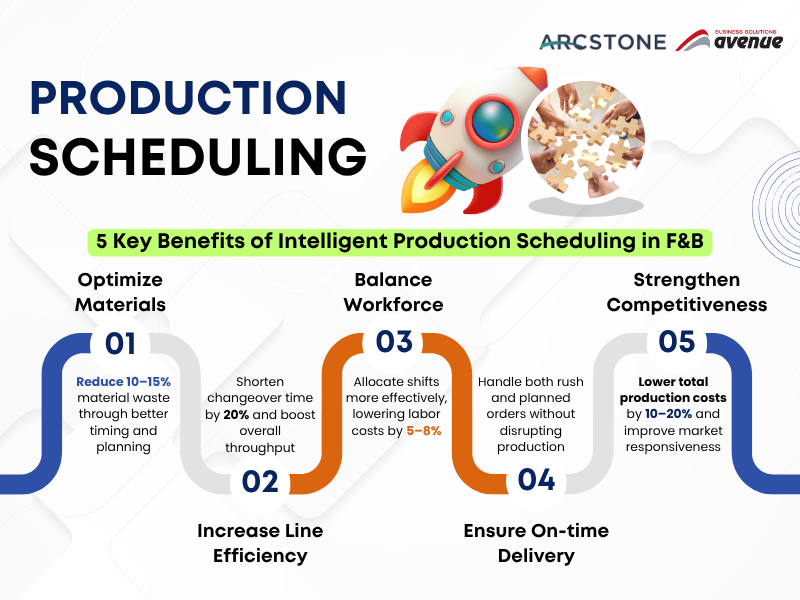
📊 Optimized production scheduling can help F&B manufacturers reduce 10–20% of total production costs. But many still use manual planning. It’s time to digitalize and optimize. The Food & Beverage (F&B) industry faces constant pressure: perishable materials, volatile demand, and tight delivery deadlines. In this environment, production scheduling becomes a strategic tool for competitive advantage.
The Common Reality
Many factories still use Excel or manual planning, leading to:
Waste
Spoilage from improper material timing
Delays
Late orders due to slow adaptation to demand spikes
Overload
Overburdened staff from imbalanced shifts
Inflexibility
A single urgent order disrupting the entire line.
Optimization Opportunities for F&B
The goal is to move beyond mitigating risks and seize opportunities:
Materials
Reduce waste by 10–15% with just-in-time usage
Production Lines
Shorten changeover times by 20% through optimized sequencing
Workforce
Lower labor costs by 5–8% with balanced shift allocation
Delivery
Fulfill all orders reliably to maintain retailer credibility
According to McKinsey, optimized scheduling can reduce total production costs in the F&B industry by 10–20%.
Elements of a Modern Scheduling System
An intelligent scheduling system for F&B must include:
Automation
Seamlessly connect orders, materials, machinery, and personnel
Real-time Visibility
Instantly view inventory and production line progress
What-if Simulation
Test scenarios like rush orders, machine breakdowns, or material delays
Frozen Zone
Stabilize confirmed schedules to prevent disruptions
Integration
Connect with ERP, MES, and SCM for a single source of truth
Arcstone MES – Production Scheduling: An Example
Arcstone’s Production Scheduling module optimizes F&B operations by providing:
- Automated schedule creation from Sales Orders to Work Orders.
- Intelligent allocation of resources.
- Instant adjustments to urgent orders or disruptions.
- User-friendly tools like drag-and-drop, what-if simulations, and a frozen zone.
- A modular design for standalone implementation without a full IT system overhaul.
The key differentiator: it empowers businesses to not only react but to continuously optimize based on real-world data.
In the F&B industry, intelligent planning is the foundation for a sustainable competitive advantage through:
✅ More efficient use of materials.
✅ Smoother production line operations.
✅ More balanced workforce management.
✅ Higher customer satisfaction.
👉 For F&B manufacturers, transitioning from Excel to an intelligent scheduling system is a strategic move to meet today’s demands while building a solid foundation for the future.